Early ages 3rd century
Three meters away from the conference room and the main house at Kvevli, a shaft hole axe was found in greenstone dated 300 AD in 1967. The axe bears witness to farm work and forest clearing before the Viking Age. Kvevli farm is one of the oldest farms in the area. Kvevli was originally a secondary settlement established on early agriculture estimated AD 0-300. The axe is currently owned by the University of Oslo.
The name Kvevli comes from a Viking word Vin, which means meadow or grassland. There are 11 people in Norway who have Kvevli as their surname and are probably descendants of the farm.
Foss, Church, Royal estate, Nesøya Estate from 1360 to 1666
Kvevli is first mentioned in a diploma from 1360 where the farm was owned by the Peter Foss at Blaker. The next time the farm is mentioned is 1390 and was owned by the Oslo bishop's estate where the Catholic St. Halvard's Church was a co-owner. The king seized the estate and was briefly under the ownership of the royal estate after the Reformation in 1536. The Kvevli farm was one of the few farms in full operation throughout the Black Death. The farm is mentioned again in the mid-1500s. In the late Middle Ages, the farm was owned by the Nesøya estate and further by the Rosenkrantz family.
The Nesøya estate was divided up in the first half of the 1600s. Østen from Ringebu bought the farm in 1647. Furthermore, it was sold to Torkil Olsen in 1666. From the High Middle Ages, the farm was considered a fully operated farm.
The users of Kvevli
The first user who registered was named Tosten and lived here in 1528.
The next user is called Sakse in 1593, and in 1616 the user was called Kristoffer. In 1647, the user was named Lars Hansen b1614-d1665. Kvevli was divided between two farms in 1660 and was called Store Kvevli (Large Kvevli). The first user for this part was Peder Hansen b1627-d1699. Married to Ragnhild. In 1699 his son Engebret Pedersen b1676-d1736 married to Berte Toresdatter d1712 took over. They had two children, Anders and Helge, in 1708 and 1710, but both children died less than a year.
Berte died shortly after. Engebret Pedersen remarried to Kjersti Andersdatter the year after Berte died in 1713. They had a daughter Ragnhild Engelbretsdatter in b1715 -d1777. Ragnhild took over the farm for a short period before it was sold on in 1754 to Kristoffer Toresen from Monsrud b1714-d1801 and his wife Mari Olsdatter b1713-d1766. They had two children. Johannes b1743 and Ole b1745. Kristoffer transferred the ownership of Kvevli to his son Johannes Kristoffersen in 1775, who became unmarried. In 1801 he was living on the farm with his father and three servants. A few years earlier he chose to transfer the farm to his nephew Berger Olsen in 1798. b1774-d1832 married to Anna Maria Hansdatter Sørlie b1779-d1820. They had Mari b1805, Berte 1808-1809. Ole 1810-1820. Hans 1812-1859.
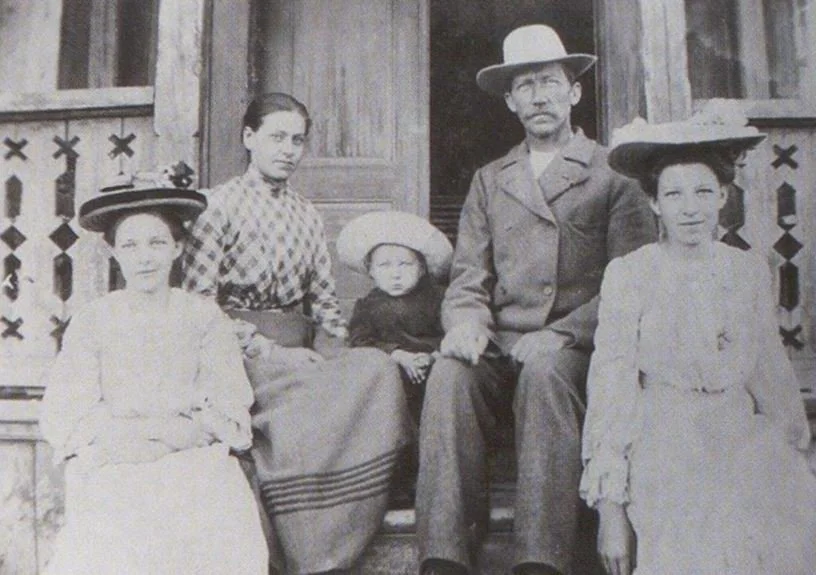
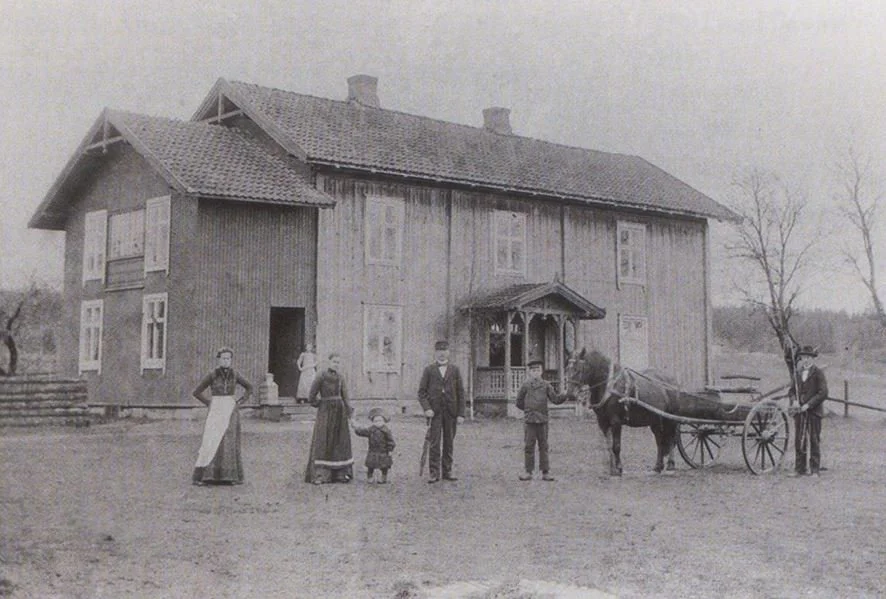
Berger Olsen was taxed with 38 silver coins in 1816, which was the highest sum anyone at Kvevli was assessed for. In 1830 he gave the deed to the farm to his daughter Mari Bergersdatter 1805-1875 and his son-in-law David Torstensen Skjefstad from Toten. Mari Bergersdatter was the last from the old family to live at Kvevli. In 1852 they sold the farm to Han Carl Pettersen 1822-1888 and his wife Anne Petrine Hansdatter 1829-1910. Child Jørgine Teoline 1856-1857, Hans Bernhard 1858-1886 and Borgar Olaf 1860. In 1900 she had become a widow and still lived on the second floor of the main building.
In 1900, the farm had two horses, ten cows, eight sheep and four pigs. His son Borgar Olav took over the farm in 1895. He married Kaja Olsdatter. In 1898, Borgar Olaf fell to his death from working on the roof of the main house.
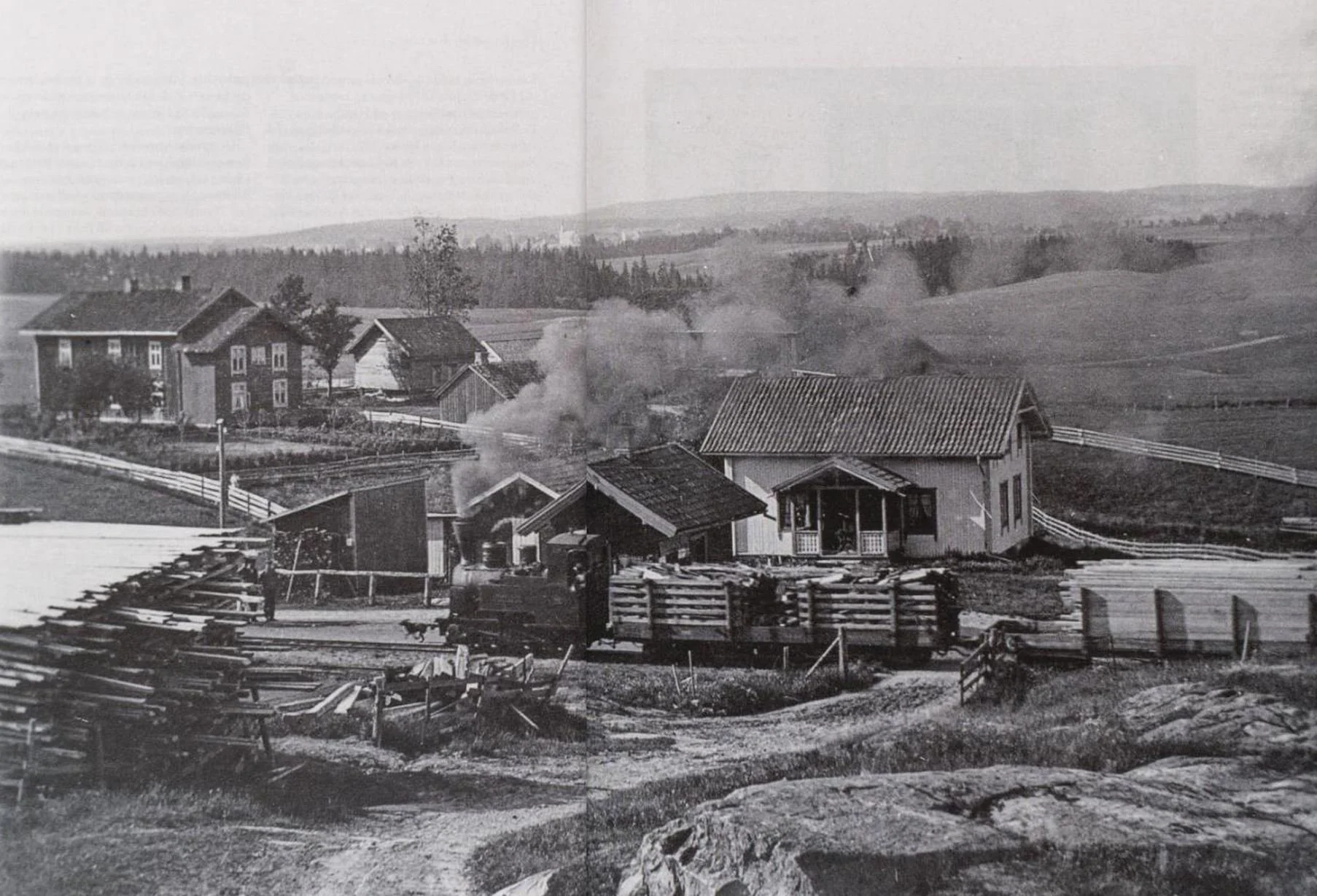
Kvevli train station 1896-1960
The Aurskog-Høland Railway was built in 1896. The farm had its own stop, known as Kvevli Station; this was established due to the significant potential for exporting timber and milk from the local farms. Although the railway line closed in 1960, a station serving the museum railway and a 100-year-old steam locomotive is located just a ten-minute walk from the farm, with trains running every Sunday between June 14 and September 13. The original milk churns from 1900 that were used on the train are now kept in the farm’s storehouse at Kvevli.
The owners of Kvevli in modern times
In 1903, widow Kaja sold the property to Halvor Olsen 1862-1915 and his wife Emma Andreasdatter 1871-1950. They lived here shortly before Kvevli was sold again to Mikal Svendsen 1866-1948 and his wife Marie Bjerke 1871-1943. They originally came from Sørumsand. Mikael was a local grocer in Sørumsand and delivered milk at the train station at Kvevli. In 1922, his son Alf Svendsen 1899-1989 and his wife Dagny Huser 1902-1985 took over
In 1967, his son Alf Gullerud took over, who found Greenstone axe in the garden same year. Married to Marit Gullerud 1929-2023. In 2007, the farm was divided from the barn to a local farmer. In 2017, Jan Kåre and Veronica bought the farm. In 2025, Øyvind Rundgren took over the farm.